
Brass & Copper Tarnish Removal
Laser Cleaning of Brass and Copper
 Laser cleaning is an advanced, non-contact surface preparation and restoration technology increasingly adopted for brass and copper components across industrial, electrical, heritage, and precision manufacturing applications. This article explains the physical principles of laser cleaning, evaluates its effectiveness on brass and copper alloys, and discusses process parameters, advantages, limitations, and typical use cases.
Brass and copper are widely used due to their excellent electrical conductivity, corrosion resistance, thermal properties, and aesthetic appeal. Over time, however, these materials accumulate surface contaminants such as oxides, sulfides, oils, greases, carbon deposits, coatings, and handling residues. Traditional cleaning methods—chemical pickling, abrasive blasting, or mechanical polishing—often introduce environmental concerns, dimensional changes, or surface damage.
Laser cleaning provides a precise, environmentally friendly alternative that selectively removes surface contaminants while preserving the base metal. Laser cleaning works through controlled laser–matter interaction. When laser energy is applied to a surface the contaminants absorb laser energy more readily than the underlying metal. There is rapid localized heating causes contaminants to vaporize, decompose via photothermal and photomechanical effects. Typically, a brass or copper substrate
reflects a large portion of the laser energy, limiting thermal penetration and preventing damage when machine settings are properly selected.
Within industry today there are two types of lasers. The first is a pulsed fiber lasers (typically 50–500 W). These are preferred for brass and copper due to their high peak power and precise energy control. They are ideal for oxide removal, fine components, and delicate surfaces. The second is continuous-wave fiber lasers (500–3000 W) which may be used for heavy contamination. However, careful control of the process parameters is required due to higher heat input and the reflective nature of copper alloys.
Copper and brass are highly reflective in the near-infrared wavelength range commonly used by fiber lasers (≈1064 nm). This presents challenges but also advantages. These include: high reflectivity which reduces the risk of substrate damage; high thermal conductivity which rapidly dissipates heat and minimizes localized melting and last selective absorption by oxides and contaminants that enables controlled cleaning. Because of these properties, laser cleaning parameters must be optimized to ensure efficient contaminant removal without excessive energy input.
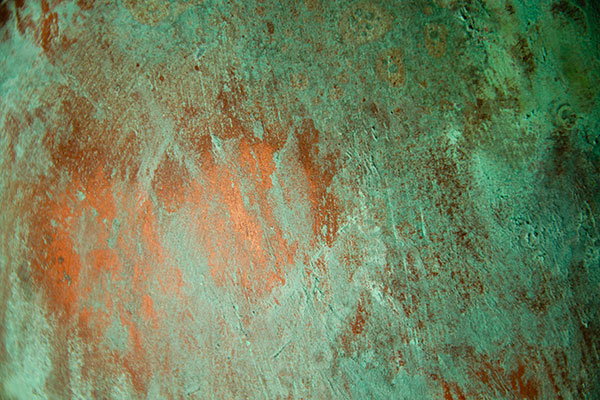
Oxide and tarnish removal are common surface contaminants that are removed from copper and brass sheets or components. In particular these are copper oxides (CuO, Cu₂O), sulfide tarnish, heat discoloration and atmospheric corrosion films. Laser cleaning effectively breaks the bond between these layers and the substrate, restoring surface conductivity and appearance without altering dimensions.
Key laser parameters for brass and copper cleaning include:
- Laser power: Typically 50–300 W (pulsed) for precision work
- Pulse duration: Nanosecond range for controlled ablation
- Pulse frequency: Adjusted to balance removal rate and surface finish
- Scan speed: Higher speeds reduce heat input
- Spot size: Smaller spots allow fine detail control
- Overlap rate: Ensures uniform cleaning
There are several advantages of laser cleaning brass and copper. No abrasives are used, therefore no surface erosion or dimensional change. The process is chemical free with selective removal to preserve the original surface texture. The process is environmentally friendly with minimal waste or secondary pollution. The process is versatile and highly controllable technology for the precise surface removal requirements.
Process considerations should include initial equipment costs, process controls and safety requirements for eyewear, and fume extraction.
Laser cleaning applications are often focused toward the electrical and electronic components. The cleaning of copper bus bars and terminals, oxide removal prior to welding, brazing, or soldering and surface preparation for coatings and plating.
Precision and mechanical components such as valves, fittings, and machined brass parts, mold inserts, tooling components and restoration of fine features without polishing. Heritage and restoration of brass and copper artifacts are often laser cleaned the tarnish removal can be controlled without loss of the patina detail. Use within manufacturing and maintenance focuses on in-line cleaning prior to assembly and maintenance of copper heat exchangers and contacts.
Laser-cleaned brass and copper surfaces typically exhibit uniform matte or lightly satin finish, improved wettability for coatings or joining, enhanced electrical conductivity and no embedded media or chemical residues. Also surface roughness remains largely unchanged when compared to abrasive methods.
In conclusion laser cleaning is a highly effective and sustainable solution for cleaning brass and copper surfaces and components. By leveraging the selective absorption properties of surface contaminants and the reflective nature of copper alloys, laser systems deliver precise, repeatable results without damaging the substrate. As adoption grows across manufacturing, electrical, and restoration industries, laser cleaning continues to replace traditional chemical and mechanical methods for copper-based materials.