
Steel & Concrete Bridge Structures
Laser Cleaning of Steel & Concrete Bridges for Repair and Rehabilitation
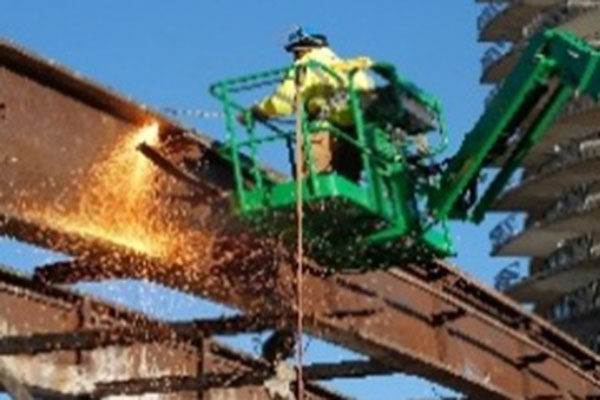 Aging bridges — particularly steel structures — suffer from corrosion, rust build-up, degraded coatings, and contaminated concrete surfaces, all of which compromise structural integrity and long-term durability. Traditional methods (abrasive blasting, chemical stripping, mechanical grinding) often have environmental, safety, and performance limitations (waste, surface damage, secondary pollution). Laser cleaning has emerged as an alternative that removes corrosion products, old paint, and contaminants with minimal substrate damage and without abrasive media.
Laser cleaning uses focused beams (continuous or pulsed) to ablate or vaporize surface contaminants, with energy selected so that the underlying metal or concrete remains intact. It can also be integrated with other laser-based repair techniques (e.g., cladding or welding).
Laser Cleaning of Steel Bridge Components for rust & corrosion is relatively new technology. One of the clearest technical studies in bridge-type steel cleaning applications is as follows:
Wang et al. (2022) — Laser cleaning on severely corroded steel members: engineering attempt and cleanliness assessment
- Compared dry laser cleaning (DLC) vs wet laser cleaning (WLC) against abrasive blasting.
- Found that laser cleaning can efficiently remove corrosion products and salts, comparable to abrasive blasting, with WLC giving superior micro-cleanliness and lower thermal impact.
- Mechanistically, ablation, melting, and evaporation are the dominant removal processes, efficiently exposing bare metal.
- Laser cleaning also prolongs re-corrosion time by reducing residual contaminants.
WANG’S key technical points include:
- Excellent Surface characterization (3D microscopy, electron microscopy) was used to verify surface cleanliness.
- Continuous-wave high-power lasers (kW class) can be used on large structural members.
Implication: Laser cleaning isn’t just a lab curiosity — proven on real corrosion scenarios relevant for in-service bridges.
Across studies, common underlying physical mechanisms include laser ablation whereby rapid heating of rust/paint layers causes material removal by vaporization without bulk heating of the substrate. The melting/evaporation of the surface contaminants break the adhesion from the substrate. With appropriate machine parameter settings, minimal heat-affected zones (HAZ) can be maintained, leaving the steel substrate remains unaffected metallurgically. These mechanisms have been documented in corrosion experiments and supported by microscopy analyses.
Onsite field usage of laser cleaners (typically continuous lasers) requires an electrical power source and compressed air. Cleaning units range in wattage from 2000KW to 3000KW. Supplied electrical power requirements for cleaning are often achieved through the use of s portable 15Kw to 20Kw electric generator and an air compressor capable of 10SCFM. The compressed air is used for removal of dust particles in front of the laser beam which promotes cleaning efficiency.
Laser cleaning machines are typically equipped with 10 meters (30 ft.) of flexible cord that leads from the machine to the laser gun. For most models, the laser gun is controlled by the operator with an off/on switch and safety mechanism. For continuous lasers, the laser gun is held one meter or less from the workpiece where paint or rust is to be removed. Dependent upon the manufacturer, the beam width is adjustable from 25mm (1 in.) to 300mm (11.81 in.) in width.
Dependent upon the severity of the rust and/or coating(s) on the bridge component and the laser cleaning machine wattage, removal rates of 1 to 2 square meters per minute (10 to 20 square feet per minute) can be achieved. The use of Aerial Work Platforms (AWP’s) are common for laser cleaning to achieve maximum efficiency.
The laser cleaning of Concrete / Concrete Adjacent Surfaces of aged concrete bridge decks” is still emerging, but there are relevant analogues:
Gao et al. (2023) — Laser cleaning of architectural aluminum formwork with residual concrete
- Used high-energy pulsed laser to remove concrete adhesion layers.
- Removal occurred via laser interaction with microscopic water and gas bubbles in concrete, causing micro-explosive separation of concrete particles.
- Efficiency was higher for fresher residues but still provides a mechanistic basis for laser cleaning of concrete contaminants (e.g., laitance, weak surface layers).
- Laser technology can also be applicable for rust removal on concrete surfaces.
Laser parameters vary significantly relative to the & Techniques in Practice
Laser cleaning is increasingly seen not only as an isolated technique but as part of laser-assisted repair workflows:
- Laser Cleaning + Laser Cladding (LCC): blended cleaning and surface repair (cladding) for damaged steel plates has shown improved metallurgical bonding and higher surface hardness compared to manual or separate processes.
- Laser Additive Manufacturing (AM) for Bridge Repair: while not strictly “cleaning,” AM processes for repairing corroded steel beams often assume the substrate has been cleaned (laser or otherwise) prior to deposition.
There are several advantages of using laser cleaning for bridge repair and rehabilitation when compared to conventional sand blasting. These include: the use of a non-contact process reduces physical damage and substrate alteration, high precision whereby hard-to-reach or sensitive areas can be cleaned efficiently, low environmental impact which eliminates abrasive media, reduces airborne waste and bulk clean-up issues.
Other considerations include that laser cleaning may be slower when compared to sandblasting where multiple layers of rust prevent the laser beam from reaching the steel or concrete substrate. Equipment cost & training may be equal to or higher when compared to current blasting repair methods and the surface profile may create a smoother surface requiring surface roughening prior to coating. Industry discussions have affirmed this practical consideration.
In conclusion laser cleaning is a technically feasible, environmentally friendly, and increasingly optimized method for preparing steel surfaces for bridge rehabilitation and has emerging applicability toward concrete surface treatment, particularly for contaminant or degraded layers. It complements modern laser-based repair techniques and can improve longevity and performance when properly parameterized.